Insights
Code Era vs. Complexity Era: Understanding the Paradigm Shift
How AI and LLMs are fundamentally changing software validation
July 10, 2026
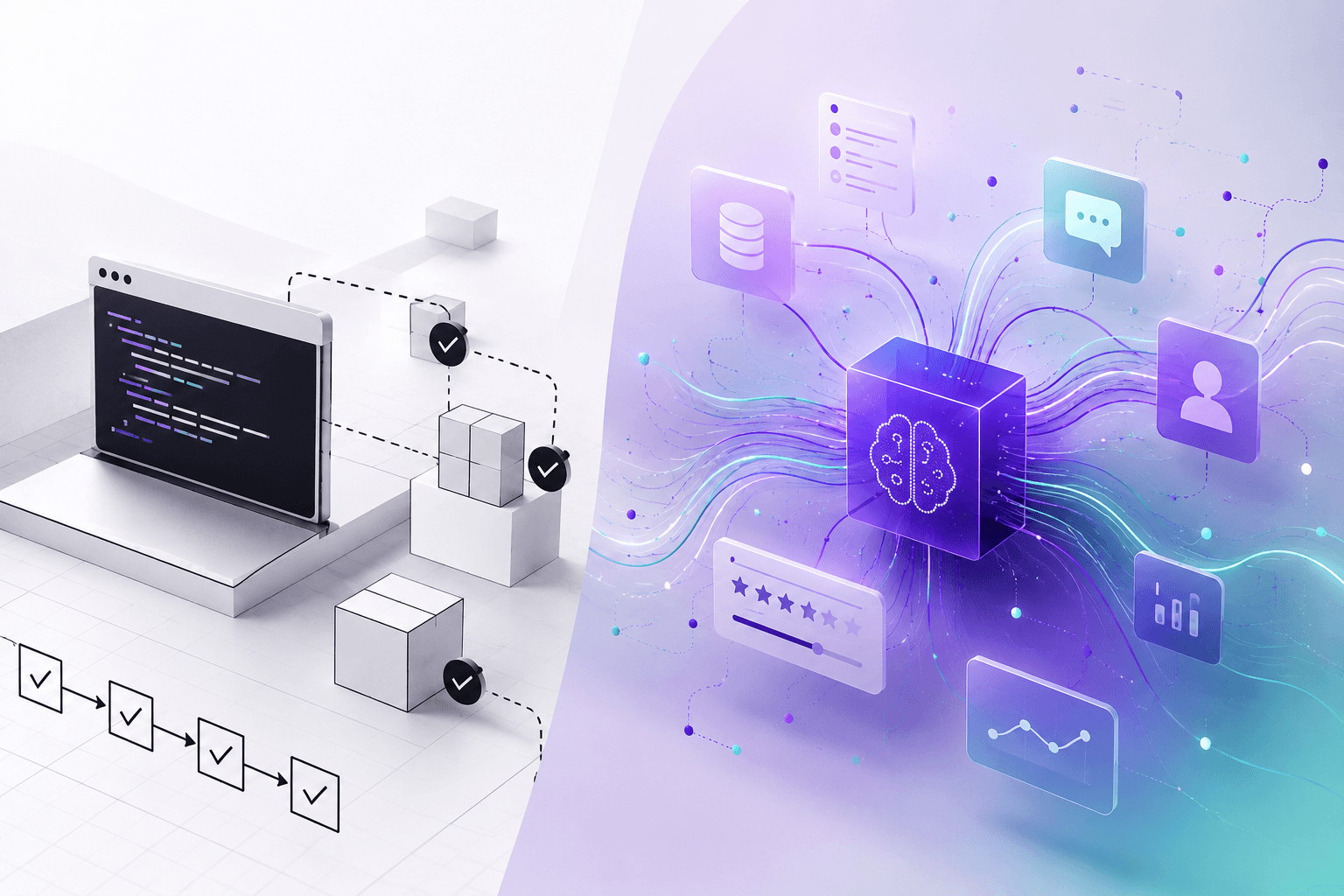
Software development has entered a new era where traditional code-only validation methods no longer suffice. The introduction of AI, LLMs, and data-driven systems has fundamentally changed how we build, test, and validate software quality.
The Fundamental Shift
The Code Era was successful because software was deterministic, objective, and predictable. If you wrote the same code twice, you got the same result. Unit tests could verify correctness with simple pass/fail assertions. Engineers owned the entire quality assurance process because the output was purely technical.
The Complexity Era changed everything. AI and LLMs introduced non-deterministic behavior, subjective outputs, and context-dependent results. The same prompt can produce different responses. Quality is no longer binary—it requires human judgment, domain expertise, and continuous evaluation across multiple dimensions.
This is the breaking point: Traditional QA methods can't handle this new reality. Unit tests can't evaluate whether an AI's response is "helpful," "safe," or "aligned with brand voice." The feedback loop that worked for decades is now fundamentally broken.
Side-by-Side Comparison
| Feature | Code Era | Complexity Era |
|---|---|---|
| Core Components | Code | Code + Data + Prompts |
| Output Nature | Deterministic, Objective | Subjective, Stochastic (Non-Deterministic) |
| Validation Method | Unit Tests (Pass/Fail) | AI Evals |
| Primary Owner | Engineer | PMs & Domain Experts (Product & Strategy) |
| Feedback Loop | Linear, Technical | Cross-Functional, Continuous, Strategic |
Understanding the Differences
Why "Code + Data + Prompts"?
AI systems require more than just code to function effectively. While code defines the structure and logic, data quality directly impacts model performance, and prompt engineering determines how well the AI understands and responds to user intent.
The interplay between these three elements creates unprecedented complexity. A bug might not be in your code—it could be biased training data, an ambiguous prompt, or an unexpected interaction between all three. Traditional debugging approaches simply don't work anymore.
Understanding Non-Determinism
Unlike traditional software, AI outputs vary even with identical inputs. Temperature settings, sampling methods, and model weights all introduce variability. This stochastic behavior is not a bug—it's a fundamental feature of how LLMs work.
For businesses, this creates new challenges: How do you ensure consistency? How do you reproduce errors? How do you guarantee quality when the same input produces different outputs? These questions require new evaluation frameworks that go beyond traditional testing.
From Unit Tests to AI Evals
Unit tests work on binary logic: pass or fail, correct or incorrect. But AI outputs exist on spectrums. Is a response "helpful enough"? Is it "safe enough"? Does it align with your brand voice? These questions require nuanced evaluation frameworks that can measure relevance, coherence, safety, and alignment.
AI evaluations (evals) require domain expert judgment to define what "good" looks like, continuous monitoring to catch edge cases, and cross-functional collaboration to balance technical feasibility with business requirements. It's a fundamentally different approach to quality assurance.
Shift in Ownership
In the Code Era, engineers could independently validate quality because "correct" was objectively measurable. In the Complexity Era, engineers can't validate AI quality alone—they don't have the domain expertise to judge whether a customer service response is appropriately empathetic, or whether a medical AI suggestion is clinically sound.
Product Managers and Domain Experts must now actively participate in defining, executing, and interpreting evaluations. Product strategy directly influences technical quality. This shift requires new tools that bridge the gap between technical and non-technical stakeholders.
The New Feedback Loop
Traditional software followed a linear feedback loop: Engineer writes code → Unit tests validate → Deploy. This worked because quality was technical and objective.
AI development requires a cross-functional, continuous feedback loop: Product defines success metrics → Engineers implement → Domain Experts evaluate outputs → Product adjusts strategy → Repeat. This loop must be continuous because AI behavior evolves with data, usage patterns, and model updates. Breaking down silos between Product, Engineering, and Domain Experts is no longer optional—it's the only way to ensure quality.
The Critical Consequences
Broken Feedback Loop
Quality can no longer be measured by simple technical metrics. The new feedback loop requires tight collaboration between Product Managers, Engineers, and Domain Experts—but no single platform supports this cross-functional workflow.
Uncatchable Errors
Evaluating subjective AI outputs is difficult, demanding Domain Experts to design and execute evaluations that catch subtle but catastrophic errors—a process that is currently manual, slow, and non-scalable.
How ChatIntel Addresses This Shift
ChatIntel is the LLM evaluation platform built specifically for the Complexity Era. We bridge the gap between technical implementation and business outcomes with cross-functional collaboration tools, domain-expert-friendly evaluation frameworks, and continuous monitoring that scales with your AI product.